You sent out thirty applications last month. You heard back from three. The easy explanation is that you are not qualified enough. The more uncomfortable explanation — the one most career advice skips — is that your resume never reached a human at all.
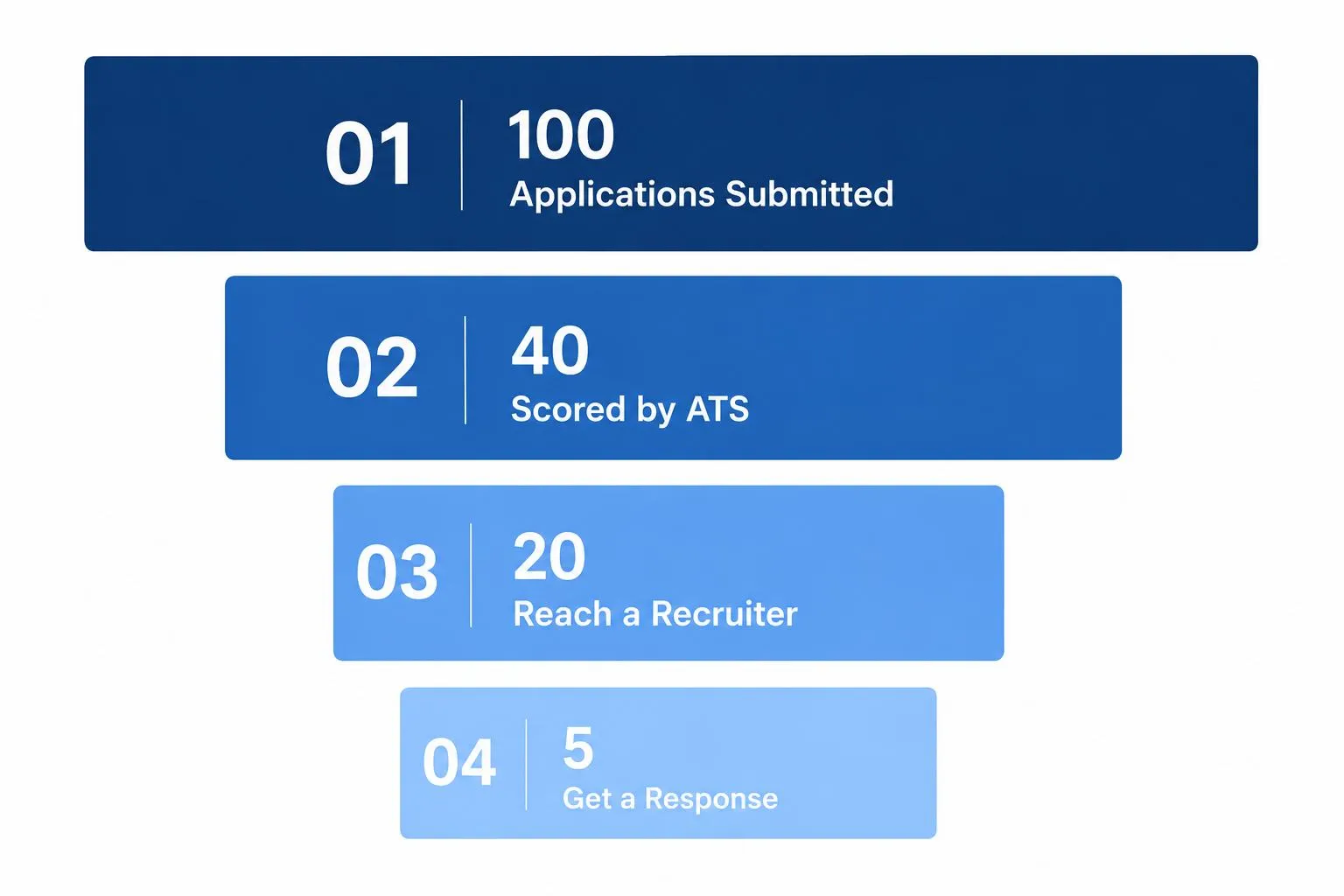
Most companies today use an Applicant Tracking System. That software receives your application, parses the text, scores it against the job description, and — depending on the company’s settings — can archive anything below a certain threshold before a recruiter ever opens the folder. No rejection email. No feedback. Just silence that you fill in with self-doubt.
The awful part is that this can happen even when you are genuinely qualified for the role. It comes down to formatting choices, word choices, and a few structural decisions that most people make without realising they are self-sabotaging.
Build a clean, ATS-friendly resume that clears the filter and lands in front of a real person.
What “auto-rejected” actually means
Nearly every mid-to-large employer now runs applications through an ATS first — by widely cited industry estimates, almost all Fortune 500 companies use one. When you submit an application through a company careers page or job board, the ATS parses your resume — extracts text, identifies sections, reads dates and job titles — and then runs a scoring algorithm against the job description. Keyword overlap is almost always the dominant signal.
Some companies use the ATS purely as an organisational tool and humans review every application. Others set hard score cutoffs. Many fall in between, with recruiters only looking at the top-ranked applications and scrolling down only when they need more candidates.
You cannot know which system a company uses. You can only control whether your resume gives the ATS enough signal to score you fairly.
Mistake 1: A design that looks great and parses as garbage
This is the most common and most painful mistake, because the resume causing it usually looks genuinely impressive.
Multi-column layouts built in Canva. Designer templates with sidebars, infographics, and skill bars. Resumes styled like a personal website. They photograph well and feel modern. What they do to an ATS is the opposite.
When a parser encounters a two-column layout, it often reads left column followed by right column as one continuous stream of text. Your job title mixes with your contact details. Your dates get merged into your skills section. The result is content that looks coherent to your eyes and reads as nonsense to the software scoring you.
Text embedded inside images or graphic elements is invisible to the ATS entirely. If you listed your skills inside a styled badge or icon block, those skills do not exist as far as the system is concerned.
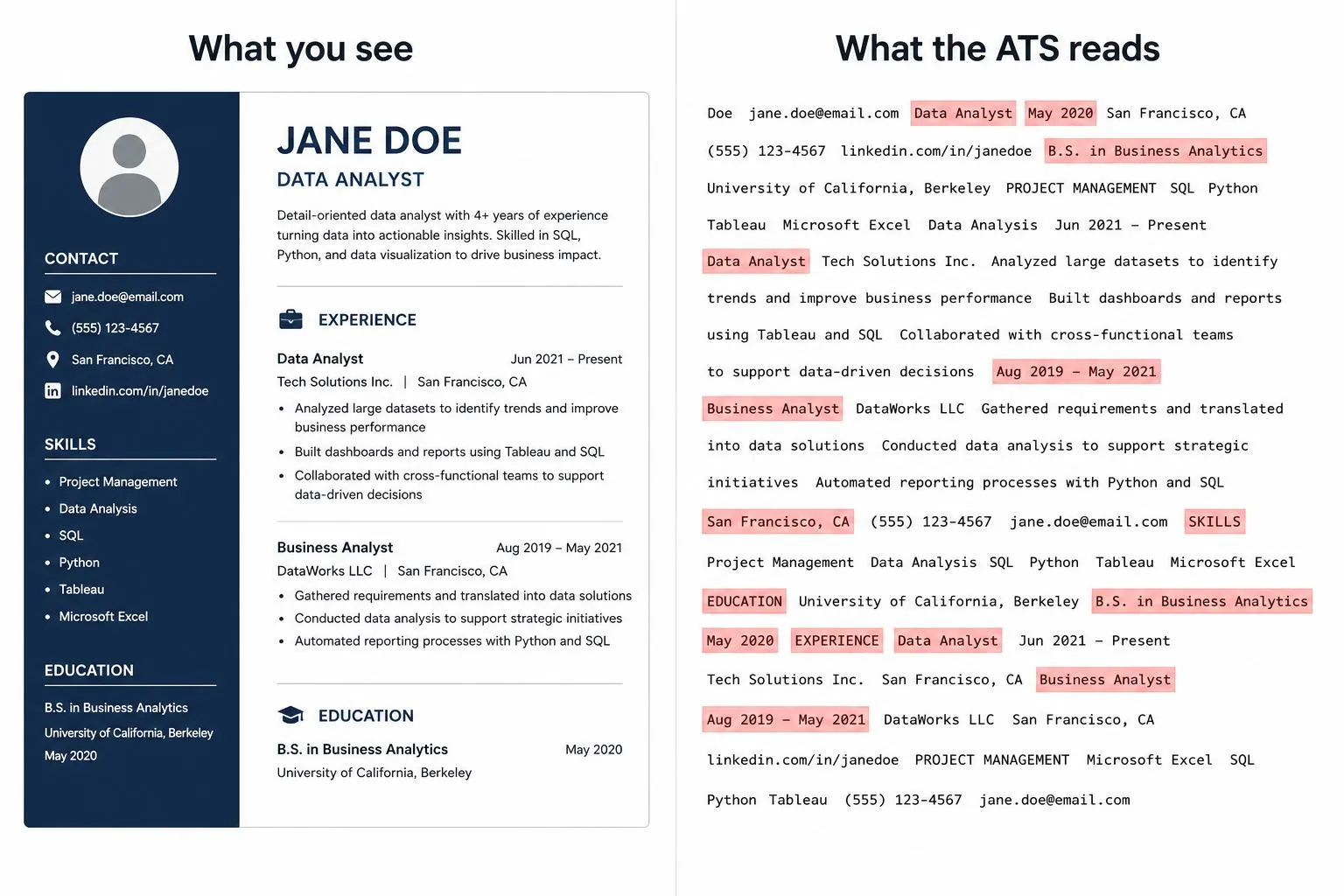
The fix: Single-column layout for any resume going through an online portal. Standard margins, no text boxes or graphics containing words. Save the designed version for when you email it directly to a person.
Mistake 2: Missing the exact keywords — or stuffing them
Keyword matching is how the ATS scores relevance. If the job posting says “project management” and your resume says “managed multiple workstreams,” you may score lower — some systems match semantically, others only match exact strings.
The common mistake is writing your resume in your own language rather than the employer’s. You worked on “client deliverables” — they want “stakeholder communication.” You did “data analysis” — they want “business intelligence” and “SQL.”
The opposite mistake is equally damaging: stuffing keywords into your resume until it reads unnaturally, or listing skills you do not actually have. Some ATS systems flag keyword density anomalies. And if you make it past the filter, the first human who reads your resume will see through it in about thirty seconds.
Mistake 3: Section headings the parser cannot read
ATS software is trained to recognise specific section labels: Experience, Work Experience, Education, Skills, Certifications. When it finds those headings, it knows what category of content follows.
When you use creative alternatives — “Where I’ve Made an Impact,” “My Toolkit,” “The Journey” — the system does not know what it is reading. Your experience bullets may get miscategorised, or the section may be ignored entirely when the parser tries to extract your job history.
This feels like a small detail. For your ATS score, it is not.
Standard headings that parse reliably: Work Experience (or Experience), Education, Skills, Certifications, Summary (or Professional Summary), Languages, Projects.
Personality in a resume comes from what you write, not what you name your sections.
Mistake 4: The objective statement that says nothing
“Motivated and results-driven professional seeking a challenging opportunity in a dynamic organisation where I can leverage my skills and experience to contribute to team success.”
You have read this sentence a thousand times because every candidate uses some version of it. It occupies valuable space at the top of your resume. It tells the recruiter nothing that is not self-evidently true of every applicant. Some version of it is probably on your resume right now.
A summary at the top of your resume is genuinely useful — when it is specific. Three sentences that answer: what you do, at what level, and what kind of role you are targeting. Someone in your industry should be able to picture your profile without reading the rest of the page.
“Front-end developer with 5 years building React applications for B2B SaaS companies. Focus areas: performance optimisation, design systems, and clean component architecture. Looking to join a product-led team building at scale.”
Specific beats generic every time.
Mistake 5: Your job title does not match industry language
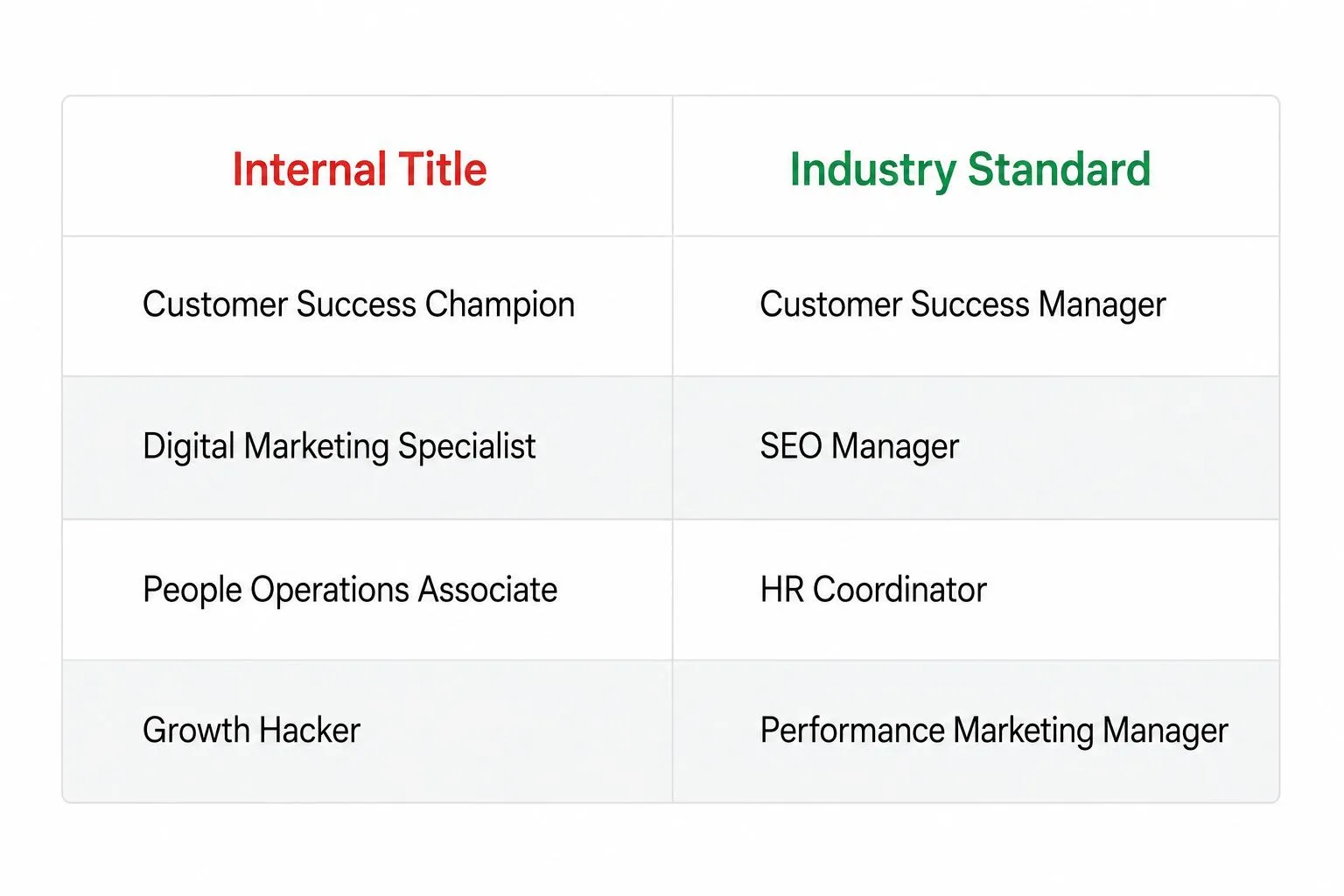
Companies search their ATS using job title keywords. If you were internally called a “Customer Success Champion” but the hiring team is searching for “Customer Success Manager” candidates, your application may not surface in those filtered views.
The same issue runs in the opposite direction: inflating your title to match the job posting. If you put “Software Engineer” when your title was “Junior Developer,” and your LinkedIn or references reflect the real title, that creates a credibility problem further down the process.
The fix: Use the most recognisable industry-standard version of your title, with your actual internal title in parentheses if they differ. This passes the ATS keyword match and the human credibility check at the same time.
Mistake 6: A skills section with bars, ratings, or stars
The five-star rating on “Microsoft Excel” you gave yourself means nothing to anyone reviewing your resume. The ATS reads it as noise. The hiring manager sees it as a signal that you have not written many resumes — anyone who genuinely knows a tool does not self-rate it with stars; they list it and prove it through their experience bullets.
Skill bars and progress indicators were a design trend from around 2015 that has outlasted its relevance. They look polished at first glance. In templates where bars are built from characters or styled elements, the ATS often reads scrambled characters attached to your skill names.
Skills section that works
- Plain comma-separated list or simple bullet points
- Grouped by category (Languages, Tools, Frameworks)
- Hard skills separate from soft skills — or soft skills dropped entirely
- Full terms alongside abbreviations (e.g. "Machine Learning (ML)")
Skills section that hurts you
- Star ratings, progress bars, or visual skill indicators
- Skills listed inside a table or multi-column grid
- Only abbreviations without the full phrase
- Soft skills like "team player" or "good communicator" — show these through bullets instead
Mistake 7: A file format that loses your text
PDF is almost always the right choice — it preserves your formatting, renders consistently across devices, and modern ATS systems handle it well.
The dangerous edge case is a PDF exported from a design tool like Canva, Adobe Illustrator, or Figma. These sometimes embed text as graphical elements rather than selectable characters. In your PDF viewer, it looks perfect. To an ATS extracting text, it is an image — unreadable.
The test takes thirty seconds: open your resume PDF and select all the text (Ctrl+A / Cmd+A), then paste it into a plain text editor. If it reads coherently in order — sections intact, no scrambled characters — the ATS can parse it. If the pasted result looks like keyboard mashing, your current resume is invisible to the system scoring you.
Mistake 8: The wrong page count for your experience level
One page if you have under ten years of experience. Two pages if you genuinely cannot cut further without removing relevant recent content. Never three.
The mistake cuts both ways. Cramming seven years of experience onto one page by shrinking margins to 0.3 inches and font size to 8pt creates a document that technically fits but is unreadable during a recruiter’s six-second scan. They move on.
Going to two pages with two years of experience signals that you cannot prioritise — a skill that matters in most knowledge work roles.
Even with a two-page resume, the page-one rule applies: recruiters make their keep-or-skip decision based on what is immediately in front of them. Your most important content — current role, most relevant experience, headline skills — needs to be on page one. Page two is for the supporting detail they will read only if page one earns it.
How to check your resume right now
You do not need specialist software for a basic ATS audit. This takes about fifteen minutes:
- 1
Run the copy-paste test
Open your resume PDF. Select all text and paste it into a plain text editor. If it reads coherently — sections in order, no scrambled output — an ATS can parse it. If it is garbled, your layout is causing parsing failures and this needs fixing before your next application.
- 2
Audit every section heading
Check each header in your resume. If any use creative or non-standard labels, rename them to the standard equivalents: Experience, Education, Skills, Summary, Certifications.
- 3
Compare keywords against the job posting
Paste the job description and your resume side by side. For every skill, tool, or qualification in the posting that you legitimately have — verify it appears in your resume using their exact phrasing. If it does not, add it where it naturally fits.
- 4
Read your summary out loud
If it could apply to any candidate in your field, rewrite it. It should be specific enough that someone could roughly guess your industry, level, and target role from those three sentences alone.
- 5
Clean up your skills section
Remove star ratings, progress bars, and skill charts. Replace with a plain text list grouped by category. This takes five minutes and removes one of the most common ATS parsing problems.
Skip the manual audit — paste your resume and the job posting and get your score in seconds.
Start from a clean, ATS-friendly template — no formatting decisions that will sink your application.
Once you have cleared these mistakes, the next step is making your resume actively impress the recruiter on the other side of the filter. That is exactly what we cover in How to Build a Resume That Gets Past the Bots and Impresses Hiring Managers.
Frequently asked questions
How do I know if a company uses auto-rejection?
You generally cannot. Companies do not publish their ATS configuration. Large enterprises and high-volume recruiters are the most likely to use score-based filtering. The safest assumption for any application submitted through an online portal is to optimise for ATS scoring.
If my resume passes the ATS, is the hard part over?
Passing the ATS gets you in front of a human. From there, different rules apply — visual clarity, achievement-focused bullets, and relevance to the specific role matter more than keyword density. The ATS is the first filter, not the last.
Can I use a designed resume at all?
Yes — when you are sending it directly to someone rather than through a portal. If you have a referral and are emailing a hiring manager, a well-designed resume can work in your favour. Through an online application system, use the plain version.
Why did I not get a rejection email?
Most ATS platforms only trigger rejection emails when a recruiter actively marks an application as rejected. Applications that are never opened or auto-archived by score often never trigger that step, so nothing gets sent.
Should I have a different resume for every job?
You do not need to rewrite from scratch. Adjust your summary, confirm the relevant keywords from the job posting are present, and reorder your top bullets to match what they care about most. Usually fifteen to twenty minutes per application — and it meaningfully changes your match score.
Is it worth paying for a professional resume writer?
For senior roles where the compensation difference makes the investment clearly worthwhile, potentially. For most job seekers, a clean template combined with honest achievement-focused writing and careful keyword alignment will outperform an expensive rewrite. The problems on this list are structural — they are not solved by better prose, but by better formatting and keyword strategy.